If you run a small business, chances are you already use plenty of software.
Accounting tools. A CRM you meant to set up properly. A scheduling app. Maybe a project management tool. Probably a few spreadsheets too, just in case.
On paper, all of this software is supposed to make life easier. In reality, it often does the opposite.
Instead of saving time, software can add friction. Instead of creating clarity, it can create clutter.
Instead of helping you focus on your business, it can start pulling you away from it.
And that is the real problem.
The Quiet Software Overload Most Small Businesses Live With
Most small businesses do not deliberately choose complexity. It creeps in over time.
You start with one tool to solve one problem. Then another tool to solve the next problem. Eventually, you are juggling half a dozen systems that do not talk to each other very well.
A typical small business might be using:
Accounting or invoicing software
A CRM for customers or leads
A task or project management tool
Scheduling or calendar software
Email and messaging tools
Marketing platforms
File storage and document tools
Individually, each tool makes sense. Together, they can create a scattered workflow.
Important information lives in different places. Tasks fall through the cracks. Data gets entered more than once. People begin relying on memory because the system is harder to manage than the work itself.
That is when software stops being helpful and starts feeling like a burden.
When Software Becomes Another Job
This is the part many software companies do not talk about.
Small business owners can develop a quiet sense of frustration around their tools.
You know the software is supposed to help, but:
It takes too long to learn.
It asks for more information than you have time to enter.
It was built for much larger teams.
You use only a fraction of what you are paying for.
So you improvise.
You fall back on spreadsheets. You keep notes in your phone. You remember things in your head. You create workarounds that make sense to you, even if the official system says you should work differently.
You tell yourself you will clean everything up later. Later rarely comes.
Over time, the technology that was supposed to reduce stress becomes another source of it.
The Real Issue Is Not Features. It Is Friction.
Modern business software loves features. Dashboards. Automations. Integrations. Advanced reporting. Custom fields. Configuration screens. For some organizations, all of that can be useful. But many small businesses need something much simpler.
Know where customers stand.
Keep work organized.
Avoid entering the same information twice.
Save time instead of spending it managing software.
Feel in control of what is happening.
When software adds friction instead of removing it, it fails its most basic purpose.
The problem is not that small businesses need more tools. They need tools that fit better.
Simpler Software Does Not Mean Limited Software
Simpler software is not software with fewer capabilities simply for the sake of having fewer capabilities.
It is intentional software.
It focuses on the work people actually need to accomplish and removes the things that get in the way.
Software designed for small businesses should:
Be easy to understand without extensive training.
Focus on core workflows instead of obscure edge cases.
Reduce steps instead of adding them.
Match the way people actually think and work.
When tools are easy to understand, people use them. When people use them consistently, information becomes more reliable. When information is reliable, operations become easier to manage. That is where productivity comes from. Not from having more features. From having fewer obstacles.
Good Software Should Fade Into the Background
If you are evaluating software for your business, there is a simple test worth considering.
If it feels like work just to keep the software updated, it may be too complex for what you need.
Good tools support your day instead of demanding your attention.
They help you stay organized without making you feel like you have suddenly taken on a second job as a system administrator.
That is why the right question is not always, “What else can this software do?”
Sometimes the better question is, “How much of this do we actually need?”
Customer management. Jobs or projects. Scheduling. Follow-ups. Basic reporting.
For many small businesses, doing those things well and consistently creates far more value than having dozens of capabilities nobody uses.
Simplicity Is a Design Decision
Software complexity is often treated as unavoidable. It is not.
Many systems become complicated because they attempt to solve every possible problem for every possible customer.
But when software is designed around a clear audience and a clear workflow, something different becomes possible.
The software can become smaller without becoming weaker. More focused without becoming restrictive. Easier to use without becoming simplistic.
Software should reduce the amount of work required to run the business, not create a new category of work.
Before adding another application, ask whether the real problem is missing functionality or whether the tools you already have are creating too much fragmentation and friction.
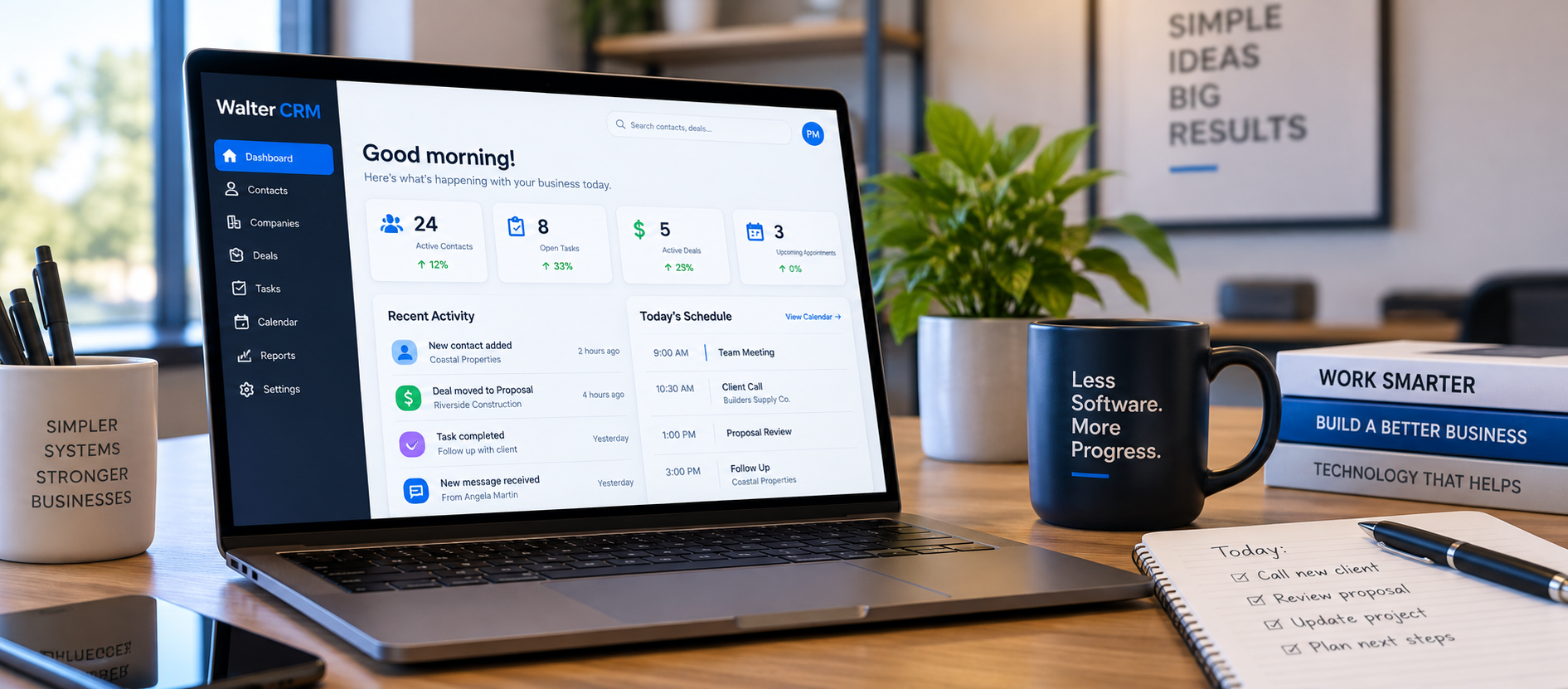
This Is the Thinking Behind Walter CRM
This philosophy also influences the products we build at PXM Software Solutions.
Walter CRM was created around a straightforward idea: smaller businesses should not need an enterprise system just to stay organized.
The goal is not to compete by adding every feature imaginable.
The goal is to make customer management, follow-up, organization, and everyday business activity easier to manage without unnecessary complexity.
Walter CRM
Learn more about Walter CRM , a customer relationship management platform built with simplicity and small business workflows in mind.
Software Should Feel Helpful, Not Heavy
Running a small business is already complicated enough. Your software should not make it harder. The goal is not to have the most advanced system.
The goal is to have a system that works reliably, consistently, and with minimal effort.
One that supports your day instead of competing for your attention.
Small businesses do not necessarily need more software. They need software that makes the business feel simpler.
More From PXM Software Solutions
Explore more practical thinking on software, automation, artificial intelligence, and business technology.